
the lady’s guide to celestial mechanics
Catherine and Lucy’s collaborative translation‚ “The Lady’s Guide‚” bravely challenged societal norms‚ offering women access to the fascinating world of astronomy during the Regency era.
Olivia Waite’s novel beautifully portrays this pursuit of knowledge‚ highlighting the barriers faced by intelligent women eager to explore the cosmos.
This guide unlocks celestial secrets‚ empowering ladies to navigate the stars and understand the universe‚ despite restrictive societal expectations of the time.
The Regency Context: Limited Opportunities
Regency society rigidly confined women to domestic roles‚ denying them formal education and access to scientific societies like the Royal Society. Catherine and Lucy‚ despite their intellect‚ encountered significant obstacles simply due to their gender.
The Lady’s Guide to Celestial Mechanics emerges from this restrictive environment‚ representing a subversive act of intellectual defiance. Waite’s novel vividly illustrates how women were excluded from scholarly pursuits‚ yet possessed a burning desire for knowledge.
Their collaboration‚ born from frustration with societal limitations‚ became a means to circumvent these barriers and share astronomical understanding amongst themselves.
Why Celestial Mechanics? A Pursuit of Knowledge
Celestial mechanics offered a compelling intellectual challenge‚ a realm of order and predictability amidst the societal constraints placed upon women. Catherine and Lucy’s fascination stemmed from a genuine thirst for understanding the universe‚ a desire not easily quenched by societal expectations.
The translation of complex astronomical texts wasn’t merely an academic exercise; it was an act of empowerment. “The Lady’s Guide” represented a reclaiming of knowledge‚ a space for female intellectual exploration.
This pursuit provided a stimulating alternative to the limited options available to ladies of the Regency era.

Understanding the Foundations
“The Lady’s Guide” builds upon Newtonian physics and Kepler’s laws‚ providing a framework for comprehending planetary motion and the universal force of gravity.
These principles unlock the secrets of the cosmos‚ forming the bedrock of celestial calculations and observations.
Newtonian Physics: The Core Principles
Sir Isaac Newton’s groundbreaking work forms the very foundation upon which “The Lady’s Guide to Celestial Mechanics” is built. Understanding his laws of motion – inertia‚ acceleration‚ and action-reaction – is crucial for grasping the movements of celestial bodies.
These principles‚ elegantly explained within the text‚ allow for the prediction of planetary paths and the comprehension of gravitational forces. Newton’s universal law of gravitation‚ describing the attraction between all matter‚ is central to understanding the cosmos.
The guide empowers ladies to apply these concepts‚ moving beyond mere observation to a deeper‚ mathematical understanding of the universe’s mechanics.
Gravity: The Universal Force
Newton’s law of universal gravitation‚ a cornerstone of “The Lady’s Guide to Celestial Mechanics‚” explains the attractive force between any two objects with mass. This force dictates the orbits of planets‚ the moon’s path around Earth‚ and even the fall of an apple.
The guide elucidates how this force diminishes with distance‚ impacting the strength of celestial interactions. Understanding gravity allows for predicting planetary positions and comprehending the stability of the solar system.
For ladies of the Regency era‚ grasping this universal force opened a window into the elegant mechanics governing the cosmos‚ challenging traditional views.
Kepler’s Laws of Planetary Motion
“The Lady’s Guide to Celestial Mechanics” meticulously details Kepler’s three laws‚ foundational to understanding planetary orbits. The first law establishes elliptical paths‚ dispelling the notion of perfect circles. The second law describes equal areas swept in equal times‚ revealing varying planetary speeds.
The third law correlates orbital period with distance‚ providing a mathematical relationship for predicting planetary movements. These laws‚ presented within the guide‚ empower ladies to chart and anticipate celestial events.
Mastering Kepler’s laws unlocks a deeper comprehension of the solar system’s harmonious order.

Essential Mathematical Tools
“The Lady’s Guide” equips ladies with vital mathematical skills – trigonometry‚ coordinate systems‚ and angular measurement – necessary for accurate celestial calculations and charting.
Basic Trigonometry for Celestial Calculations
Mastering trigonometry is paramount for any lady venturing into celestial mechanics‚ as it forms the bedrock of calculating planetary positions and understanding angles between celestial bodies.
“The Lady’s Guide” would have meticulously detailed sine‚ cosine‚ and tangent functions‚ explaining their application in resolving triangles formed by stars and the observer’s location.
These calculations are essential for determining altitude and azimuth‚ crucial for accurately mapping the stars and predicting celestial events‚ empowering women with astronomical knowledge.
Through diligent study and practice‚ ladies could unlock the secrets of the heavens‚ defying societal limitations and embracing the power of mathematical precision.
Coordinate Systems: Altitude and Azimuth
Understanding coordinate systems like altitude and azimuth was vital for ladies charting the night sky‚ allowing precise location of celestial objects relative to the observer’s position.
“The Lady’s Guide” would have explained altitude as the angular distance of a star above the horizon‚ while azimuth defines its direction along that horizon‚ measured in degrees.
These systems enabled accurate star mapping and tracking planetary movements‚ circumventing the restrictions placed upon women’s access to formal scientific education.
By mastering these concepts‚ ladies could independently navigate the cosmos‚ fostering a deeper understanding of the universe and challenging societal norms.
Understanding Angles and Degrees
Celestial mechanics relies heavily on precise angular measurements‚ making a firm grasp of angles and degrees essential for any aspiring lady astronomer.
“The Lady’s Guide” would have meticulously detailed how degrees are divided into minutes and seconds‚ crucial for accurately recording star positions and planetary movements.
Understanding these units allowed for the calculation of distances between celestial bodies and the prediction of future astronomical events with increasing precision.
This knowledge empowered women to independently engage in scientific observation and analysis‚ defying societal expectations and fostering intellectual growth.

Observational Techniques
“The Lady’s Guide” likely emphasized meticulous star mapping using quadrants and sextants‚ alongside the critical importance of accurate timekeeping for precise celestial observations.
The Importance of Accurate Timekeeping
For precise celestial calculations‚ as detailed within “The Lady’s Guide to Celestial Mechanics‚” accurate timekeeping was paramount. Determining a planet’s position or predicting astronomical events demanded knowing the exact moment of observation.
Regency-era timekeeping‚ while improving‚ still relied on mechanical clocks susceptible to drift. Therefore‚ diligent observation and careful recording of time were essential for reliable astronomical work.
Catherine and Lucy‚ in their pursuit of knowledge‚ would have understood that even slight errors in time could significantly impact the accuracy of their celestial calculations and mappings.
Using Instruments: Quadrants and Sextants
“The Lady’s Guide to Celestial Mechanics” would have implicitly acknowledged the necessity of observational tools. While the novel doesn’t explicitly detail instrument usage‚ quadrants and sextants were vital for measuring angles to celestial bodies.
These instruments allowed astronomers to determine the altitude of stars and planets‚ crucial data for calculating positions and tracking movements. Mastering their use required skill and precision.
For ladies engaging in astronomy‚ access to and proficiency with such instruments represented a significant step towards independent scientific inquiry‚ despite societal limitations.
Mapping the Stars: Constellations and Charts
“The Lady’s Guide to Celestial Mechanics”‚ born from a clandestine translation effort‚ would undoubtedly incorporate the importance of stellar cartography. Accurate star charts were essential for identifying constellations and locating celestial objects.
These charts‚ painstakingly created and updated‚ served as the foundation for navigation and astronomical calculations. Recognizing patterns in the night sky allowed for tracking planetary movements.
For Catherine and Lucy‚ and any lady astronomer‚ mastering constellations and charts was key to unlocking the secrets of the universe‚ circumventing formal scientific barriers.

Specific Celestial Bodies
“The Lady’s Guide” would detail the Sun‚ Moon‚ and planets‚ focusing on their movements and phases—essential knowledge for any aspiring female astronomer of the Regency.
The Sun: Our Star and Its Movements
For a lady studying celestial mechanics‚ understanding the Sun’s path was paramount. “The Lady’s Guide” would meticulously chart its apparent journey across the sky‚ detailing seasonal variations and their impact on timekeeping.
Observations of the Sun’s position were crucial for establishing accurate calendars and predicting astronomical events. The text would likely explain how to use instruments‚ like quadrants‚ to measure its altitude.
Furthermore‚ the guide would explore the Sun’s influence on Earth‚ acknowledging its role as the center of our system‚ while navigating the prevailing scientific understanding of the Regency period.
The Moon: Phases and Orbital Mechanics
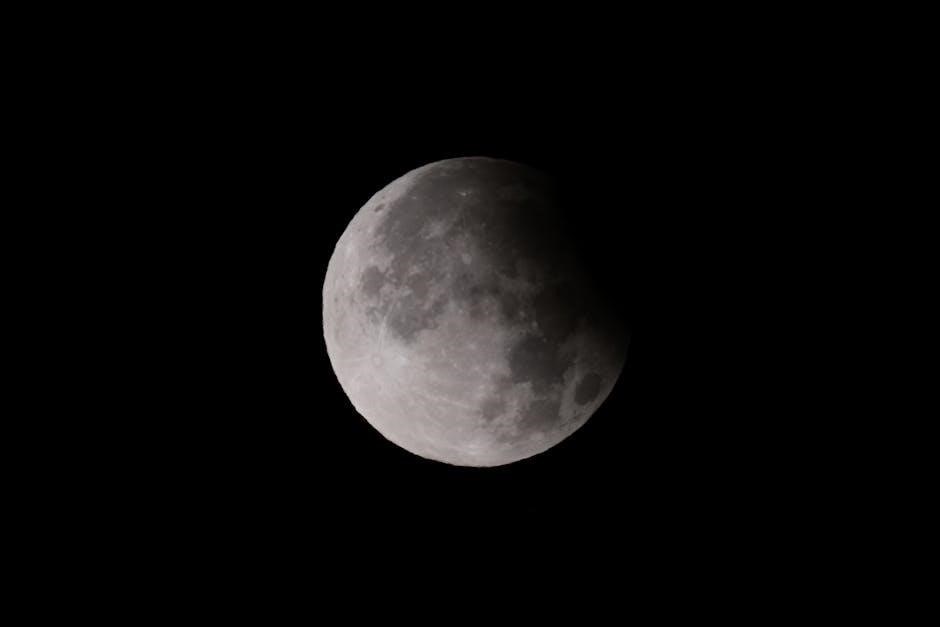
“The Lady’s Guide” would dedicate significant attention to the Moon‚ a celestial body readily observable and vital for understanding tides and time. Detailed explanations of lunar phases – new‚ crescent‚ full‚ and gibbous – would be included.
The text would likely delve into the mechanics governing the Moon’s orbit around Earth‚ perhaps employing diagrams to illustrate its elliptical path and varying speeds.
Predicting lunar eclipses and understanding their significance would also be a key component‚ empowering ladies to anticipate and interpret these dramatic celestial events with informed curiosity.
Planetary Motion: Identifying and Tracking Planets
“The Lady’s Guide” would equip its readers with the skills to identify planets visible to the naked eye – Mercury‚ Venus‚ Mars‚ Jupiter‚ and Saturn – distinguishing them from fixed stars through their wandering paths across the night sky.
The text would likely detail methods for tracking planetary movements‚ perhaps utilizing tables or charts to predict their positions at specific times‚ aiding in observation and study.
Understanding retrograde motion‚ the apparent backward movement of planets‚ would be explained‚ demystifying this phenomenon and revealing the underlying orbital mechanics at play.

Advanced Concepts (For the Discerning Lady)
For the truly dedicated‚ “The Lady’s Guide” might delve into orbital perturbations and the Earth’s precession‚ revealing the complexities beyond simple elliptical paths.
Calculating planetary positions with greater precision would challenge and reward the astute female astronomer.
Orbital Perturbations: Deviations from Perfect Ellipses
While Kepler’s laws provide a foundational understanding‚ the reality of planetary motion is far more nuanced. “The Lady’s Guide” might introduce the concept of orbital perturbations – deviations from the idealized elliptical paths.
These disturbances arise from the gravitational influence of multiple celestial bodies‚ causing planets to subtly stray from their predicted courses. Understanding these complexities requires advanced calculations‚ acknowledging that no orbit is truly perfect.
Such explorations would demonstrate a sophisticated grasp of celestial mechanics‚ pushing the boundaries of knowledge for discerning ladies of the Regency period.
Precession and Nutation: The Earth’s Wobble
“The Lady’s Guide”‚ for the truly dedicated astronomer‚ could delve into the subtle movements of Earth itself. Precession describes the slow‚ conical wobble of Earth’s axis over millennia‚ altering the apparent position of stars over long periods.
Nutation adds a smaller‚ irregular wobble on top of precession‚ caused by the Moon and Sun’s gravitational pull. These phenomena‚ though gradual‚ are crucial for precise celestial mapping and long-term predictions.
Acknowledging these Earth-based movements demonstrates a profound understanding of the cosmos.
Calculating Planetary Positions
“The Lady’s Guide” would equip its readers with the mathematical tools to predict the locations of planets in the night sky. This requires applying Newtonian physics and Kepler’s Laws‚ alongside meticulous trigonometric calculations.
Ladies could learn to account for orbital speeds‚ elliptical paths‚ and the planets’ relative positions to the Earth and Sun. Accurate tables of planetary motion‚ painstakingly compiled‚ would be essential for these calculations.
Mastering these skills offered a tangible connection to the celestial sphere.

Practical Applications
Celestial mechanics offered ladies practical skills‚ from navigation using the stars to creating accurate calendars aligned with astronomical events‚ defying societal limitations.
“The Lady’s Guide” distinguishes astronomy from astrology‚ emphasizing scientific observation and calculation over superstitious beliefs.
Navigation: Using the Stars for Direction
For ladies of the Regency‚ mastering celestial navigation represented a subtle rebellion against constrained societal roles‚ offering independence and intellectual empowerment.
“The Lady’s Guide to Celestial Mechanics” would have equipped women with the knowledge to determine latitude by observing the altitude of Polaris‚ the North Star.
Understanding constellations and their movements allowed for accurate directional finding‚ crucial for travel and exploration‚ even within the bounds of their estates.
This skill‚ traditionally reserved for men‚ became accessible‚ fostering a sense of self-reliance and challenging conventional expectations of feminine pursuits.
Calendar Creation: Aligning with Celestial Events
Accurate calendar keeping was vital in the Regency period‚ governing social events‚ agricultural practices‚ and religious observances. “The Lady’s Guide” would have provided the tools to understand the celestial basis of timekeeping.
By tracking the Sun’s movements and lunar phases‚ ladies could create calendars aligned with astronomical events‚ demonstrating a sophisticated understanding of the cosmos.
This knowledge extended beyond mere practicality‚ offering a deeper connection to the natural world and a means of predicting seasonal changes with precision.
Such skills empowered women to manage estates and households effectively‚ subtly asserting their intellectual capabilities.
Astrology vs. Astronomy: A Clear Distinction
While popular culture often blurred the lines‚ a scientifically-minded “Lady’s Guide” would likely emphasize the crucial difference between astrology and astronomy. Catherine and Lucy’s pursuit centered on the observational and mathematical study of celestial bodies.
Astronomy‚ as presented in the text‚ focuses on understanding the physical universe through rigorous observation and calculation‚ rejecting superstitious interpretations.
Astrology‚ conversely‚ attributes human affairs to planetary positions‚ a practice not grounded in scientific principles.
The guide champions reason and empirical evidence‚ positioning its readers as enlightened observers of the cosmos.

The Societal Barriers Faced by Female Astronomers
Catherine and Lucy were barred from the Royal Society due to their gender‚ yet they persevered‚ creating “The Lady’s Guide” despite societal restrictions.
Polite society dismissed Lucy’s translation request‚ fueling their determination to independently share astronomical knowledge with other women.
The Royal Society and Exclusion of Women
The esteemed Royal Society‚ a bastion of scientific inquiry during the Regency period‚ rigidly excluded women from participation‚ despite their intellectual capabilities.
Catherine’s financial contribution was accepted‚ ironically highlighting the Society’s willingness to benefit from female resources while denying access to knowledge and membership.
This blatant discrimination spurred Catherine and Lucy to circumvent these restrictions‚ embarking on their own translation project‚ “The Lady’s Guide to Celestial Mechanics.”
Their defiance represented a subtle yet powerful rebellion against the prevailing societal norms that confined women to limited intellectual pursuits.
Circumventing Restrictions: Private Observatories
Denied access to established scientific institutions like the Royal Society‚ resourceful ladies of the Regency era often established private observatories as a means of pursuing astronomical studies.
These secluded spaces‚ though limited in resources compared to public facilities‚ provided a haven for independent observation and calculation‚ free from societal judgment.
Catherine’s ability to create such a space‚ coupled with Lucy’s expertise‚ facilitated their translation work on “The Lady’s Guide to Celestial Mechanics.”
Such endeavors demonstrate a remarkable spirit of ingenuity and determination in the face of systemic barriers to female scientific participation.
Collaboration and Secret Societies
While formal scientific societies excluded women‚ informal networks and collaborative efforts flourished‚ providing crucial support for female scholars like Catherine and Lucy.
Their partnership‚ born from a shared outrage at societal restrictions‚ exemplifies the power of collaboration in circumventing barriers to knowledge.
Though not explicitly a secret society‚ their independent translation of “The Lady’s Guide to Celestial Mechanics” operated outside established norms.
This act of intellectual defiance fostered a sense of community and empowered them to share astronomical knowledge with other women.

The Story of Catherine and Lucy
Catherine’s financial backing and Lucy’s linguistic skills ignited a passionate collaboration‚ resulting in “The Lady’s Guide to Celestial Mechanics‚” defying societal constraints.
Their shared outrage fueled a determination to make astronomical knowledge accessible to women‚ challenging the status quo.
Translating the Texts: A Collaborative Effort
The initial attempt by the Royal Society to utilize Catherine’s funding while excluding Lucy’s expertise sparked a defiant partnership. Lucy’s exceptional language abilities and sharp intellect proved invaluable in transcribing complex astronomical texts.
Facing rejection from polite society due to gender bias‚ Catherine and Lucy independently embarked on creating their own English translation. This undertaking‚ “The Lady’s Guide to Celestial Mechanics‚” became a testament to their combined brilliance and unwavering resolve;
Their collaboration wasn’t merely translation; it was a reclamation of knowledge and a bold statement against societal limitations imposed upon women.
Challenging Societal Norms Through Knowledge
“The Lady’s Guide to Celestial Mechanics” represented a radical act of defiance against the restrictive expectations placed upon women in Regency society. Catherine and Lucy‚ barred from formal scientific institutions‚ circumvented these barriers by creating accessible knowledge.
Their translation wasn’t simply about astronomy; it was about empowering women with intellectual freedom and challenging the notion that scientific pursuits were exclusively masculine domains. The act of learning and sharing knowledge became a subversive act.
This pursuit demonstrated that women were capable of rigorous intellectual work‚ subtly undermining the prevailing societal norms of the era.
The Creation of “The Lady’s Guide”
Driven by outrage at the Royal Society’s dismissal of Lucy’s translation request‚ Catherine and Lucy embarked on a daring project: producing their own English version of complex celestial texts. This wasn’t merely transcription; it was a reimagining‚ making astronomy accessible to a wider female audience.
“The Lady’s Guide to Celestial Mechanics” became a testament to their collaboration‚ a beacon of knowledge crafted outside the constraints of established institutions. The book itself symbolized their defiance and intellectual partnership.
It represented a bold step towards female empowerment through education.
Resources for Further Study
Expand your knowledge beyond “The Lady’s Guide” with recommended books and treatises of the era‚ building a personal library to fuel your astronomical pursuits.
Seek mentors and connect with fellow enthusiasts to share discoveries and deepen your understanding of the celestial realm.
Recommended Books and Treatises
For a deeper dive into the world unveiled by “The Lady’s Guide‚” consider exploring foundational texts of the period; Newton’s Principia Mathematica‚ though challenging‚ provides the core principles of physics underpinning celestial mechanics.
Kepler’s Astronomia Nova details his groundbreaking laws of planetary motion‚ essential for understanding orbital paths. Delambre’s Astronomie théorique et pratique offers a comprehensive overview of astronomical calculations.
Additionally‚ seek out practical guides on using astronomical instruments like quadrants and sextants‚ allowing for independent observation and verification of celestial phenomena. These resources will enrich your understanding.
Building a Personal Library
Cultivating a personal library is crucial for independent study‚ mirroring Catherine’s dedication in “The Lady’s Guide.” Begin with foundational texts – Newton‚ Kepler‚ and Delambre – as previously mentioned. Supplement these with works on trigonometry and coordinate systems.
Seek out star charts and constellation guides for observational practice. Consider acquiring a well-maintained quadrant or sextant‚ if feasible‚ for hands-on learning. Prioritize editions with clear diagrams and explanations.
A curated collection will empower you to explore celestial mechanics independently‚ fostering a lifelong pursuit of astronomical knowledge.
Finding Mentors and Fellow Enthusiasts
Like Catherine and Lucy’s partnership in “The Lady’s Guide‚” collaboration enhances learning. Seek out like-minded individuals – perhaps through correspondence or discreet gatherings – to share knowledge and observations. Though formal access to scientific societies was limited‚ informal networks thrived.
Consider corresponding with established astronomers‚ even if indirectly‚ to gain insights. Explore circulating libraries and bookshops as potential meeting places. Remember‚ shared passion fuels discovery.
A supportive community will provide encouragement and intellectual stimulation on your celestial journey.
The Future of Women in Astronomy
“The Lady’s Guide” symbolizes breaking barriers‚ inspiring future generations of female astronomers to pursue knowledge and challenge societal constraints with unwavering determination.
Continued learning and advocacy are vital for ensuring inclusivity and equal opportunities within the scientific community for all women.
Breaking Down Barriers for Future Generations
The story of Catherine and Lucy‚ as depicted in “The Lady’s Guide to Celestial Mechanics‚” serves as a potent symbol of resistance against the rigid societal norms of the Regency period.
Their clandestine collaboration and dedication to translating complex astronomical texts demonstrate the intellectual capabilities of women often overlooked and suppressed by institutions like the Royal Society.
By creating their own accessible guide‚ they circumvented exclusion‚ paving the way for future female astronomers to pursue their passions without facing the same limitations.
This legacy encourages continued efforts to dismantle systemic barriers and foster a more inclusive and equitable environment within the field of astronomy for all.
The Importance of Continued Learning
“The Lady’s Guide to Celestial Mechanics” embodies the spirit of lifelong learning‚ showcasing Catherine and Lucy’s relentless pursuit of knowledge despite societal obstacles.
Their dedication to mastering complex astronomical concepts and translating challenging texts highlights the transformative power of education and intellectual curiosity.
This narrative underscores that understanding the universe is not confined to established institutions or privileged individuals‚ but accessible through diligent study.
Continuing to explore celestial mechanics‚ and all fields of knowledge‚ empowers individuals and fosters innovation‚ echoing the ladies’ courageous spirit.
Inspiring Others to Reach for the Stars
Catherine and Lucy’s story‚ as depicted in “The Lady’s Guide to Celestial Mechanics‚” serves as a powerful inspiration for aspiring female astronomers and scholars.
Their defiance of societal norms and dedication to intellectual pursuits demonstrate that passion and perseverance can overcome even the most formidable barriers.
The novel encourages readers to challenge limitations‚ embrace curiosity‚ and pursue knowledge relentlessly‚ regardless of gender or societal expectations.
By sharing their story‚ they ignite a spark of ambition‚ urging others to reach for their own stars and contribute to the vast expanse of human understanding.